Infrastructure Discovery Overview  

Wallarm Infrastructure Discovery is an agentless SaaS solution for AWS that gives security, platform, and compliance teams a defensible answer to what they have, what changed, and what is exposed. Part of the Wallarm AI Control Platform, it delivers the platform's Discover and Observe capabilities for AWS — continuous asset inventory, drift detection, and exposure surfacing across your cloud estate. Access is read-only — Infrastructure Discovery never modifies your cloud resources.
Infrastructure Discovery is distributed primarily through the AWS Marketplace listing and is available on all Wallarm Cloud instances — US and EU. See the Setup guide for the sign-up flow.
Supported cloud providers
Infrastructure Discovery currently supports AWS. Support for Azure and GCP is coming soon.
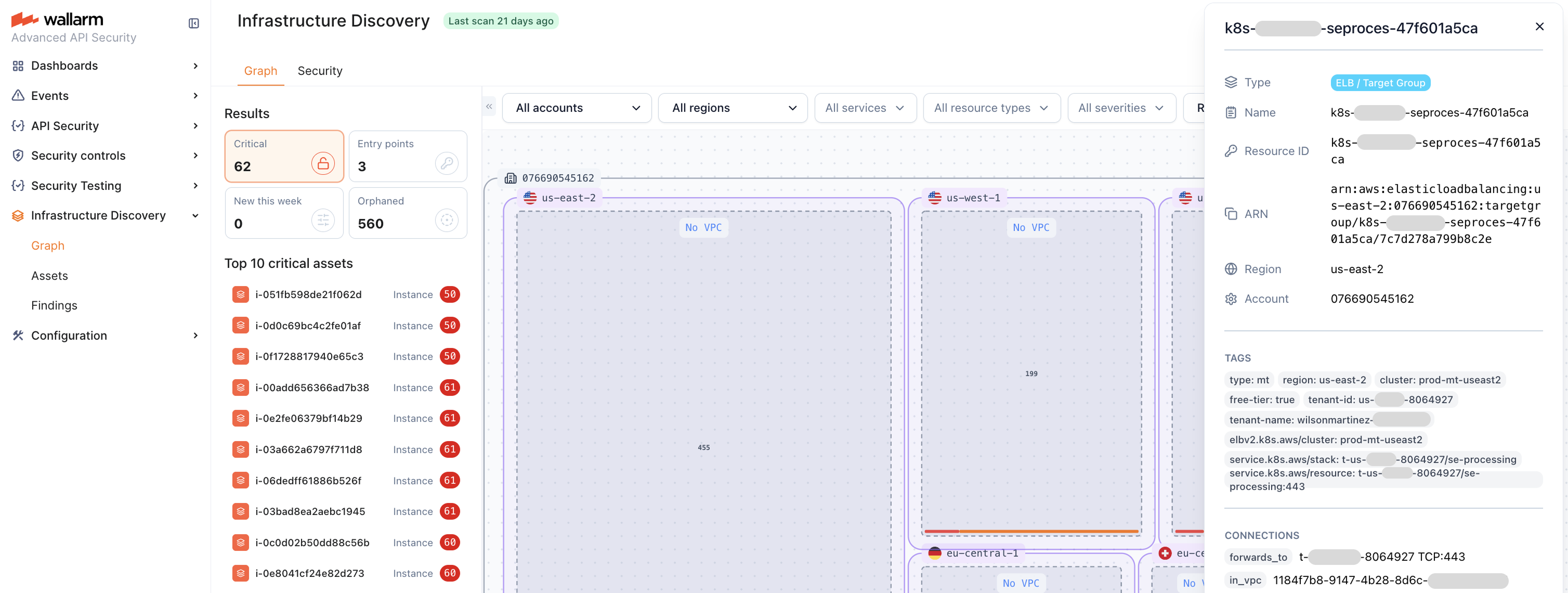
Issues addressed by Infrastructure Discovery
Modern cloud environments grow organically: teams spin up resources across multiple accounts, regions, and services. Over time, misconfigurations accumulate — publicly exposed services, overly permissive security groups, unencrypted storage — while the gap between what you think is deployed and what is actually running widens. Infrastructure Discovery closes that gap by providing:
-
Full visibility into your cloud estate — a continuously updated inventory of resources across all connected accounts and regions.
-
Relationship mapping — a graph view showing how resources connect to each other (e.g. which EC2 instances sit behind which load balancers, which security groups are attached to which ENIs).
-
Exposure detection — automatically flags resources reachable from the internet: instances and load balancers with public IPs, security groups with sensitive ports open to
0.0.0.0/0, EKS clusters with public API endpoints, and similar patterns. -
Security posture analysis — built-in rules that automatically evaluate resource configurations against security best practices, flag vulnerable setups, and surface findings with severity levels. Policies let you tune how findings are handled for your environment.
-
AWS-native finding aggregation — imports AWS Security Hub findings (Amazon GuardDuty, Amazon Inspector, IAM Access Analyzer, and more) and correlates them with discovered resources, so all findings live in one place.
-
Impact analysis — a blast radius view for each finding that shows which connected resources could be affected, helping you prioritize remediation.
-
Attack path analysis — chains individual misconfigurations into complete routes from an exposed resource to a valuable one, and identifies the single resource that breaks the most routes at once.
-
Change tracking — comparison of successive scans highlighting created, updated, and deleted resources so you can spot unintended configuration changes.
-
Creator attribution — for each asset, Infrastructure Discovery looks up the IAM principal that created it from your CloudTrail history, so every asset record carries an answer to "who made this change?".
How it works
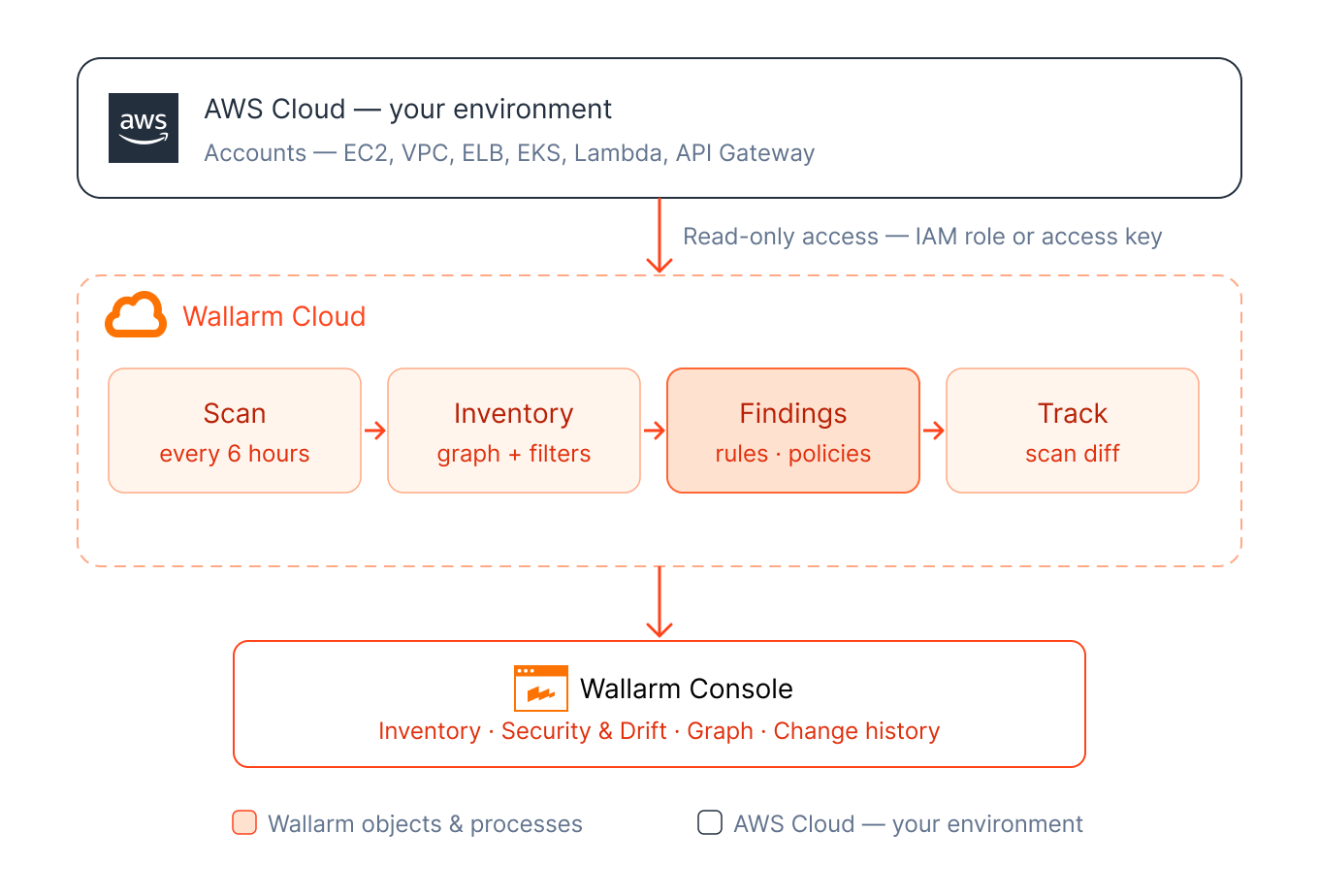
Infrastructure Discovery connects to your cloud accounts via read-only credentials and periodically scans resource metadata through the cloud provider APIs.
-
Connect — you add one or more cloud accounts by creating a cross-account IAM role or providing an access key. See Setup.
-
Scan — Infrastructure Discovery runs automated scans on a recurring schedule that enumerate resources, their configurations, and inter-resource relationships.
-
Assess security — built-in rules evaluate resource configurations against security best practices. Findings are surfaced with severity levels, and policies let you suppress or adjust them for known-benign patterns.
-
Inventory — scan results are assembled into a searchable inventory with a relationship graph. You can filter by account, region, service, and resource type.
-
Track changes — each scan is compared to the previous one. Created, updated, and deleted resources are highlighted so you can review what changed over time.
What is discovered
Infrastructure Discovery inventories resources from the following AWS services:
| AWS service | Examples of discovered resources |
|---|---|
| EC2 | Instances |
| VPC networking | VPCs, subnets, route tables, internet gateways, NAT gateways, security groups, network interfaces (ENIs), elastic IPs, VPC peering connections, transit gateways |
| Elastic Load Balancing | Application, Network, and Gateway Load Balancers; target groups; listeners and listener rules |
| EKS | Clusters, node groups, Fargate profiles |
| Lambda | Functions, layers |
| API Gateway | REST APIs, HTTP APIs, stages, VPC links |
| Route53 | Public and private hosted zones, record sets |
| IAM | Roles, users, groups, policies, access keys |
| Amazon Bedrock | Foundation models, custom models, provisioned throughput, agents, knowledge bases |
For each discovered asset, Infrastructure Discovery also queries AWS CloudTrail to find the earliest recorded event and surface the IAM principal that created the resource.
In addition to inventorying resources, Infrastructure Discovery imports existing AWS Security Hub findings and correlates them with the resources it discovers, so that third-party security signals appear alongside Wallarm's own findings.
Expanding coverage
The list of supported services and cloud providers is expanding. If you need coverage for a service not listed here, contact Wallarm Sales.
Data handling
Infrastructure Discovery stores resource metadata only — IDs, configurations, tags, and relationships. It does not access data-plane content (no S3 object reads, no RDS queries, no log reading).
All metadata is:
-
Encrypted at rest and in transit.
-
Isolated per tenant — each Wallarm account's data is stored separately with strict access controls.
-
Processed in Wallarm's cloud backend; no on-premise component is required.
For details on AWS permissions, see Setup → Required AWS permissions.