Shadow AI  





Shadow AI surfaces AI components your organization is using but has not formally approved: vendors a team started consuming without telling security, agents running on unmanaged infrastructure, MCP servers reached over DNS that have no registry footprint.
The view is app-independent. It does not require the workload to be labeled higgs.scan=enabled. Shadow AI is detected from external signals that arrive even when the in-cluster scanner has no foothold inside the calling pod. That is the point: the workloads you do not know about are the ones you cannot label.
Detection signals
AI Hypervisor recognizes shadow AI from four orthogonal signals:
-
DNS queries. Pods inside your cluster resolving hostnames that match a known AI provider (Anthropic, OpenAI, Bedrock endpoints, Cohere, Mistral, Together). Wallarm's CoreDNS log plug-in feeds these.
-
Cloud audit logs. Managed AI services consumed via AWS APIs (Bedrock invocations from accounts not in your sanctioned set, SageMaker endpoint usage) recovered from CloudTrail-style sources.
-
Ingress traffic patterns. Inbound HTTP that matches the request signature of a hosted AI provider's API, suggesting your services are exposing AI capabilities that were not declared.
-
Cross-cluster correlation. DNS or audit signals from one application pointing at endpoints another application already declared. Catches accidental cross-tenant calls.
Each signal carries enough context to identify the component and the namespace or account it was observed in, but not the per-call payload. That is the trade-off for catching unsanctioned usage you do not have an instrumentation foothold on.
What the view shows
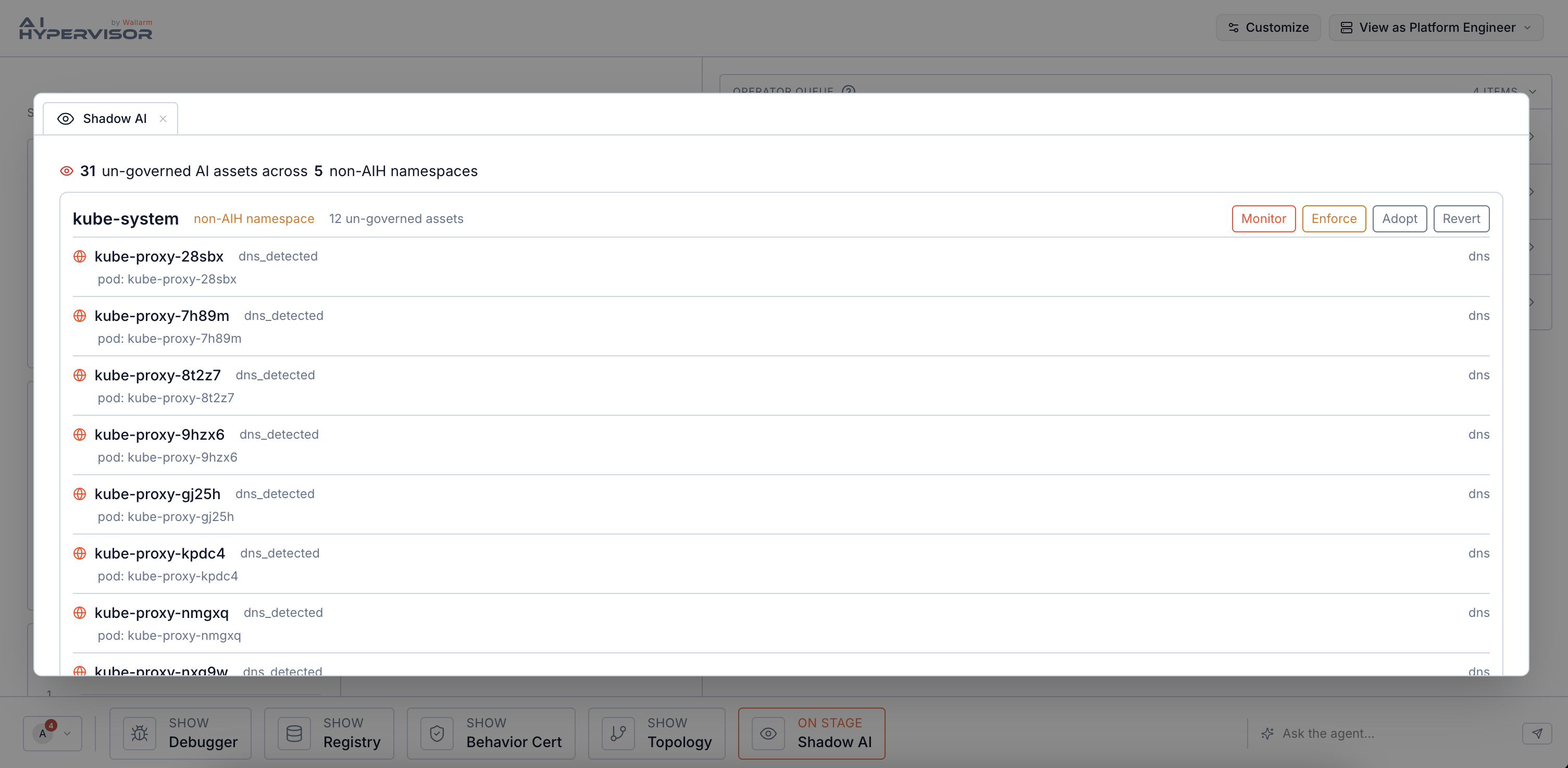
Shadow AI groups un-governed assets by the namespace where they were observed. The header reads N un-governed AI assets across M non-AIH namespaces. Each namespace becomes its own card, labeled non-AIH namespace (the namespace does not yet carry the higgs.scan=enabled label).
Under each card, the assets are listed with the signal that surfaced them: dns_detected for DNS-pattern matches, llm_egress when a known provider's request signature was seen, the resolved provider name (Anthropic, OpenAI, and so on) when the classifier was able to pin it.
Actions
Each namespace card carries four actions that operate on the whole namespace at once:
-
Monitor — keep observing without changing anything. Use this when you want the activity logged but are not yet ready to bring the namespace under AI Hypervisor governance.
-
Enforce — block subsequent un-governed calls from the namespace. The button applies the namespace-quarantine primitive (kernel-level cgroup_skb drop) — see Enforcement.
-
Adopt — bring the namespace under AI Hypervisor governance: the scanner is instructed to start observing the workloads in it as if
higgs.scan=enabledwere set, and the assets graduate out of Shadow AI into Registry. -
Revert — undo the last action applied to the namespace.
The actions surface in the Briefing Shadow-AI card and in the dedicated Shadow AI view.
Why this matters
Sanctioned governance covers what you declared. Shadow AI is the negative surface: what you did not declare that is still happening. For an EU AI Act Article 10 (data governance) audit, the auditor's first question is how do you know you did not miss something. Shadow AI is the answer: every signal AI Hypervisor recovered from outside the sanctioned set, with timestamps and namespaces, ready for review.
Cross-references
| From Shadow AI | You land in |
|---|---|
| Adopt a namespace | Registry, the namespace's workloads classified as sanctioned assets |
| Enforce on a namespace | Enforcement, the namespace-quarantine primitive |
| Investigate a signal | Debugger, the source events for the asset |
| Compliance evidence | Compliance, Shadow risk column in Findings |