# IBM QRadar via Fluentd
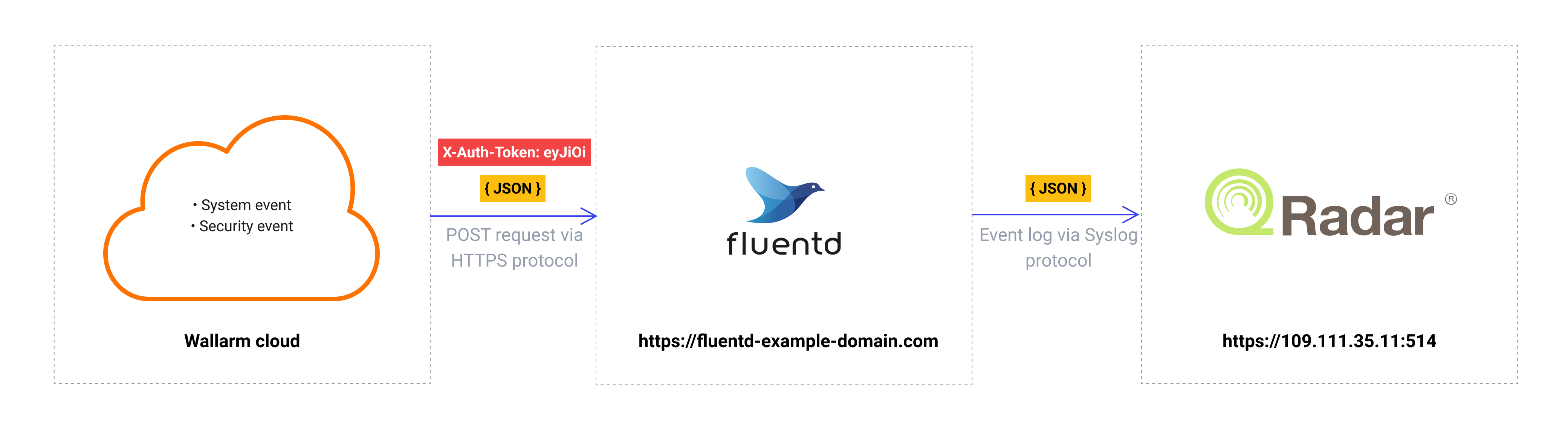
These instructions provide you with the example integration of Wallarm with the Fluentd data collector to further forward events to the QRadar SIEM system.
The most common logging scheme in complex systems consists of the following components:
* Data collector: accepts logs from several sources and forwards logs to the SIEM system
* [SIEM system](https://www.wallarm.com/what/siem-whats-security-information-and-event-management-technology-part-1) or log management systems: used to analyze logs and monitor the system status
## Used resources
* [Fluentd](#fluentd-configuration) installed on Debian 11.x (bullseye) and available on `https://fluentd-example-domain.com`
* [QRadar V7.3.3](#qradar-configuration-optional) installed on Linux Red Hat and available with the IP address `https://109.111.35.11:514`
* Administrator access to Wallarm Console in [EU cloud](https://my.wallarm.com) to [configure the Fluentd integration](#configuration-of-fluentd-integration)
!!! info "Wallarm Cloud IP addresses"
To provide Wallarm Cloud access to your system, you may need a list of its public IP addresses:
**US Cloud:**
```
34.102.90.100
34.94.156.115
35.235.115.105
34.94.85.217
34.94.51.234
34.102.59.122
34.94.238.72
35.235.100.79
34.102.45.38
34.94.241.21
34.94.203.193
34.94.238.221
34.94.9.235
34.94.118.150
34.94.193.9
```
**EU Cloud:**
```
34.141.230.156
34.91.138.113
34.90.114.134
35.204.127.78
34.90.24.155
34.7.147.149
```
**ME Cloud:**
```
34.166.215.174
```
Since the links to the Fluentd and QRadar services are cited as examples, they do not respond.
### Fluentd configuration
Since Wallarm sends logs to the Fluentd intermediate data collector via webhooks, the Fluentd configuration should meet the following requirements:
* Accept the POST or PUT requests
* Accept HTTPS requests
* Have public URL
* Forward logs to IBM Qradar, this example uses the `remote_syslog` plugin to forward logs
Fluentd is configured in the `td-agent.conf` file:
* Incoming webhook processing is configured in the `source` directive:
* Traffic is sent to port 9880
* Fluentd is configured to accept only HTTPS connections
* Fluentd TLS certificate signed by a publicly trusted CA is located within the file `/etc/ssl/certs/fluentd.crt`
* Private key for TLS certificate is located within the file `/etc/ssl/private/fluentd.key`
* Forwarding logs to QRadar and log output are configured in the `match` directive:
* All event logs are copied from Fluentd and forwarded to QRadar at the IP address `https://109.111.35.11:514`
* Logs are forwarded from Fluentd to QRadar in the JSON format according to the [Syslog](https://en.wikipedia.org/wiki/Syslog) standard
* Connection with QRadar is established via TCP
* Fluentd logs are additionally printed on the command line in JSON format (19-22 code lines). The setting is used to verify that events are logged via Fluentd
```bash linenums="1"
@type http # input plugin for HTTP and HTTPS traffic
port 9880 # port for incoming requests
# configuration for connections handling
cert_path /etc/ssl/certs/fluentd.crt
private_key_path /etc/ssl/private/fluentd.key
@type copy
@type remote_syslog # output plugin to forward logs from Fluentd via Syslog
host 109.111.35.11 # IP address to forward logs to
port 514 # port to forward logs to
protocol tcp # connection protocol
@type json # format of forwarded logs
@type stdout # output plugin to print Fluentd logs on the command line
output_type json # format of logs printed on the command line
```
A more detailed description of configuration files is available in the [official Fluentd documentation](https://docs.fluentd.org/configuration/config-file).
!!! info "Testing Fluentd configuration"
To check that Fluentd logs are created and forwarded to QRadar, the PUT or POST request can be sent to Fluentd.
**Request example:**
```curl
curl -X POST 'https://fluentd-example-domain.com' -H "Content-Type: application/json" -d '{"key1":"value1", "key2":"value2"}'
```
**Fluentd logs:**

**QRadar logs:**

**QRadar log payload:**

### QRadar configuration (optional)
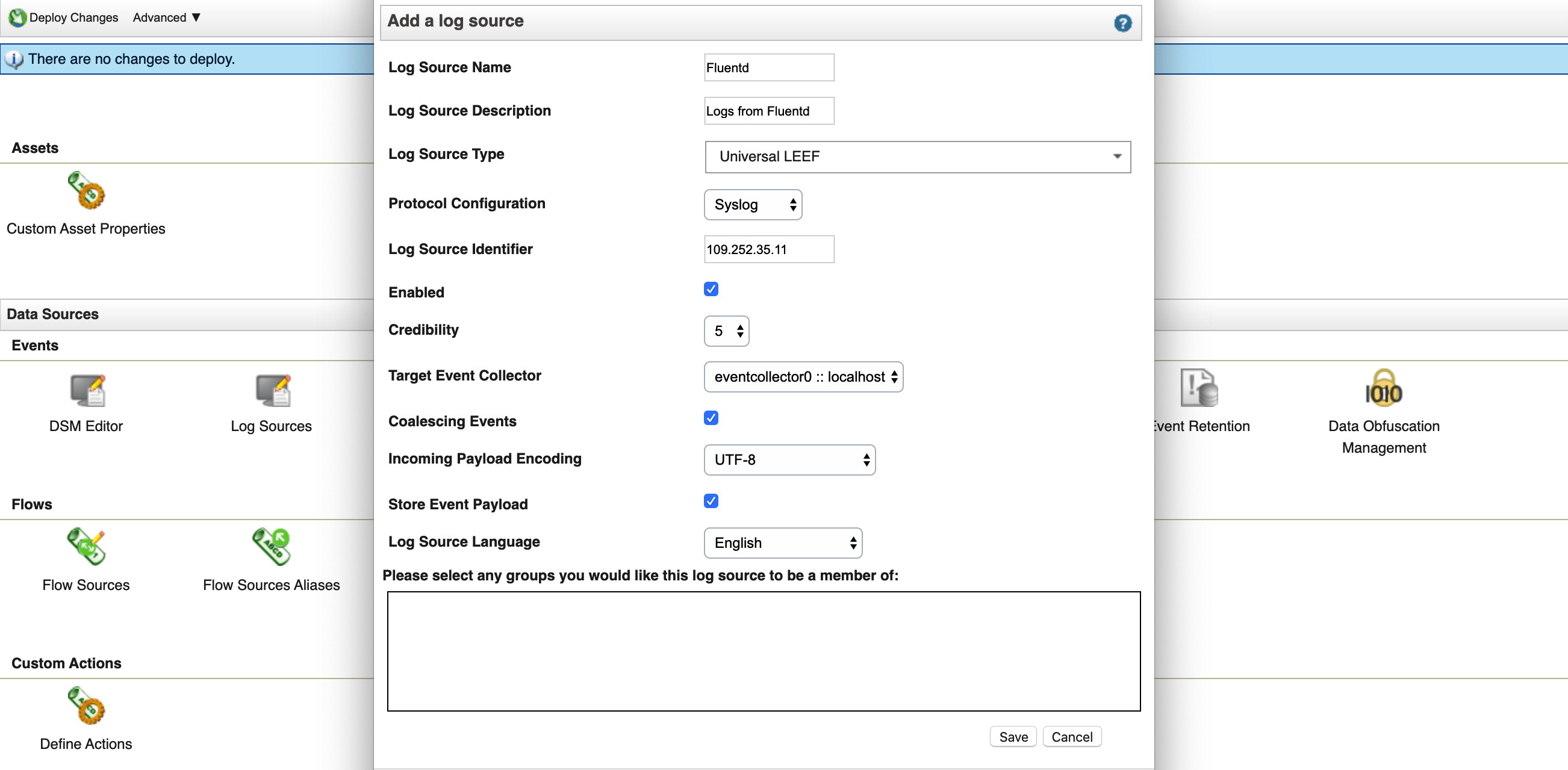
In QRadar, the log source is configured. It helps to easily find Fluentd logs in the list of all logs in QRadar, and can also be used for further log filtering. The log source is configured as follows:
* **Log Source Name**: `Fluentd`
* **Log Source Description**: `Logs from Fluentd`
* **Log Source Type**: type of incoming logs parser used with Syslog standard `Universal LEEF`
* **Protocol Configuration**: standard of logs forwarding `Syslog`
* **Log Source Identifier**: Fluentd IP address
* Other default settings
A more detailed description of QRadar log source setup is available in the [official IBM documentation](https://www.ibm.com/support/knowledgecenter/en/SS42VS_DSM/com.ibm.dsm.doc/b_dsm_guide.pdf?origURL=SS42VS_DSM/b_dsm_guide.pdf).
### Configuration of Fluentd integration
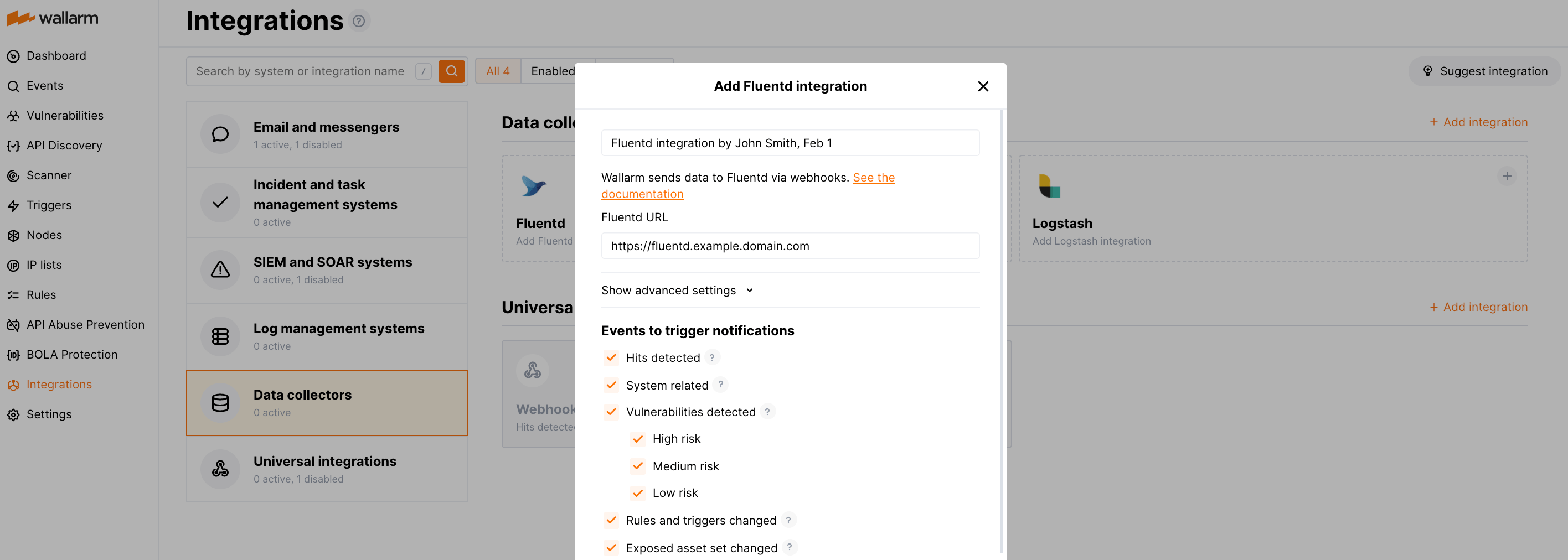
* Webhooks are sent to `https://fluentd-example-domain.com`
* Webhooks are sent via POST requests
* The webhook integration has default advanced settings
* Webhooks sent to Webhook URLs are all available events: hits, system events, vulnerabilities, scope changes
[More details on the Fluentd integration configuration](https://docs.wallarm.com/user-guides/settings/integrations/fluentd.md)
## Example testing
To test the configuration, a new user is added in Wallarm Console:
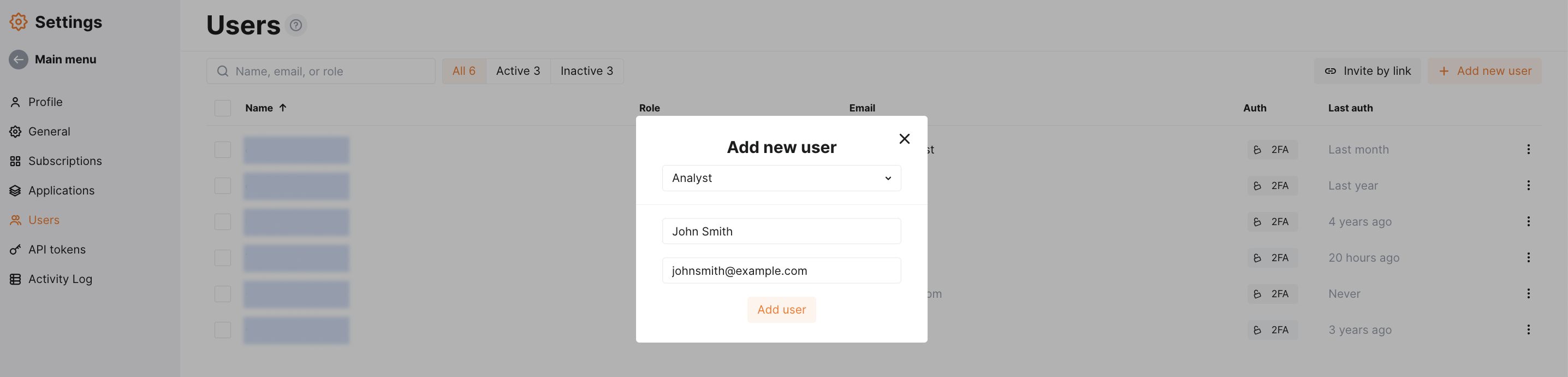
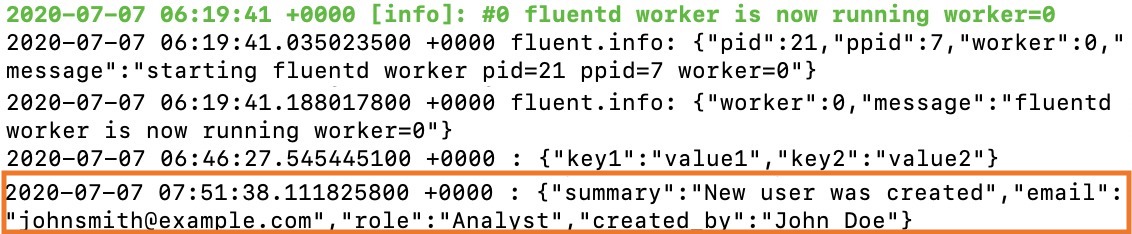
Fluentd will log the event as follows:
The following data in JSON format will be displayed in the QRadar log payload:
